
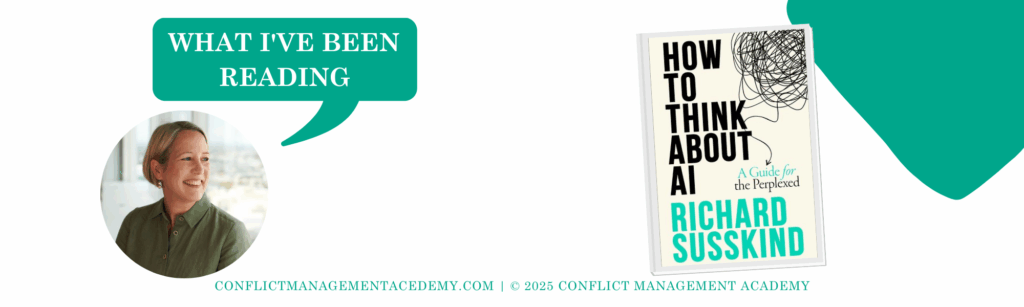
I’ve been able to avoid much of the controversy around AI, just playing around with it for fun when I’ve had some spare time, until recently. However, two things really piqued my interest. One was working with iResolve on an AI Conflict Coach (which despite my dubiousness, turned out to be astonishingly good). The second was marking university student assessment and discovering that almost all of the students used AI extensively to write their assessment (some more skillfully than others).
I really like Richard Susskind’s work. His doctorate was on AI and the law (in the mid 80s when AI was nothing like what we have today). I also read and reviewed another book he wrote with one of his sons, The Future of the Professions which was really interesting.
This is not a book that explains the technical side of AI in a lot of detail (thankfully, or I would have been quickly overwhelmed). As Susskind notes, “when systems attain a certain level of complexity, their individual daily operations often defy human explanation and understanding”.
Rather, this book is about what Susskind calls “the defining challenge of our age”: how to balance the benefits and threats of AI. It combines ideas from a broad range of disciplines, such as philosophy, anthropology, politics, social science and a little bit of science fiction, to explore what the future might bring.
The book considers uses of AI in a range of fields including medicine, law, domestic chores, transportation, and the arts. There’s also an extensive discussion about the various kinds of risks associated with AI, and AI ethics and regulation.
I was taken by Susskind’s description of “not-us” thinking. He states:
“Many, if not most, professional workers regard themselves as artists in their own craft. They look upon their work as the very embodiment of what machines will never be able to do. All manner of biases and dissonances are going on here, but the undeniable fact is that the professions and the white-collar workforce are overflowing with people who believe that AI has massive potential but ‘not for us’.”
I’ve definitely seen examples of this in the conflict resolution field. There are many practitioners who zealously speak of the need for an actual human in the work we do. For example, one section of the book explores the debate about whether AI can experience empathy, and whether the capacity to simulate empathy is enough (particularly from the perspective of the person receiving it).
Susskind explains that one of the fascinating things about AI and the debates around it, is that it makes us reflect deeply on what it means to be human:
“one of the joys of AI is that it prompts deeper consideration of the human condition, of reality and our perception of reality”
I found this book a fascinating (if occasionally disturbing) read. I would recommend it highly as an accessible resource to help us understand the potential benefits and risks of AI, and a roadmap for what is likely to happen into the future.