
The Conflict Management Academy has been running “The Mediator’s Dilemma Series” events this year, in which mediators explore a challenging hypothetical and discuss how they would deal with the dilemmas at various stages of the process. These events have been well attended and the discussions enlightening (and sometimes heated!) but what struck me after having reviewed the sessions so far is that the ethical decision making process used by participants was, well to be frank, rather ad hoc.
When mediators talk about ethics, the conversation often centres on principles we all know well: impartiality, confidentiality, and self-determination. But knowing the principles is not the same as knowing what to do when those principles collide. Real-life mediation can place us in grey zones where personal values, professional obligations, and competing priorities pull us in different directions.
In those moments, gut instinct is rarely enough. It’s worth asking: how do we make ethical choices in a way that is both principled and defensible?
Ethics and ethical dilemmas
Ethics is the process of questioning, discovering, and defending our values, principles, and purpose (The Ethics Centre). In mediation, ethical questions arise when two or more principles we hold dearly seem to conflict creating an ethical dilemma. This might be as simple as a clash between our personal sense of fairness and our professional obligation to respect parties’ self-determination.
Ethical dilemmas are not just theoretical. They appear in intake interviews, joint sessions, private caucuses, and even after a mediation has concluded. They can be subtle, like sensing one party is being unduly influenced, or dramatic, like discovering information that could prevent harm to someone outside the mediation.
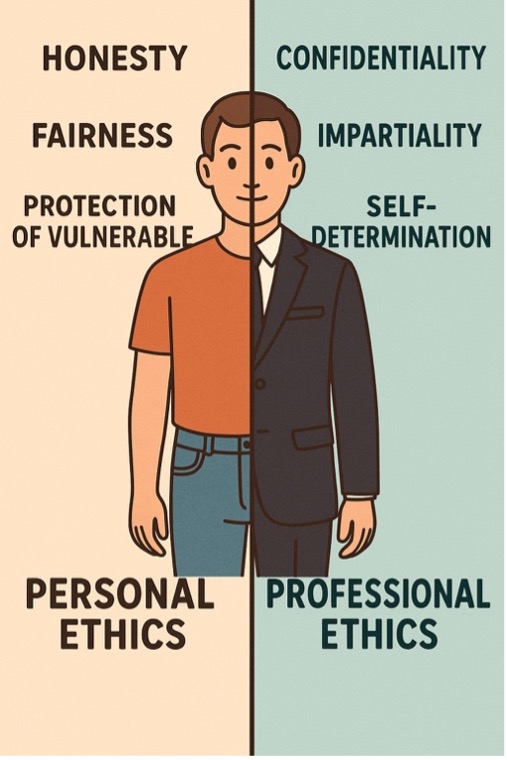
Personal and Professional Ethics
Many mediators underestimate the role of personal ethics in their professional life. Personal ethics are shaped by upbringing, culture, religion, and life experience, and they inevitably influence how we perceive conflicts and decisions.
For example, imagine being strongly pro-euthanasia, and being asked to mediate a dispute about whether someone should be able to access it. You might be able to set aside your views and remain impartial. Or you might find your values so engaged that you cannot mediate without bias or at least without the appearance of bias.
Professional ethics overlay our personal values. In Australia, mediators might refer to the AMDRAS Code of Ethics, the International Mediation Institute’s Code of Professional Conduct, or for lawyer-mediators the Law Council of Australia’s guidelines. These frameworks outline key principles, but they don’t tell us what to do in complex, context-specific dilemmas. They also don’t rank principles or explain how to decide when they are in tension.
Where Our Professional Ethics Come From
Professional ethics in mediation draw from multiple sources:
Codes of conduct issued by professional bodies (AMDRAS, IMI, etc.).
Legislation (e.g. family law provisions prioritising child welfare, or mandatory reporting laws).
Court cases that discuss ethical aspects of mediator conduct.
Academic scholarship that analyses ethical principles and categorises dilemmas.
Because no single document covers everything, mediators need a working knowledge of multiple sources and the ability to interpret them in light of the case at hand.
Ethics of mediation
Various academics and practitioners have tried to produce lists of ethical principles for mediators. There are examples in the reading list below.
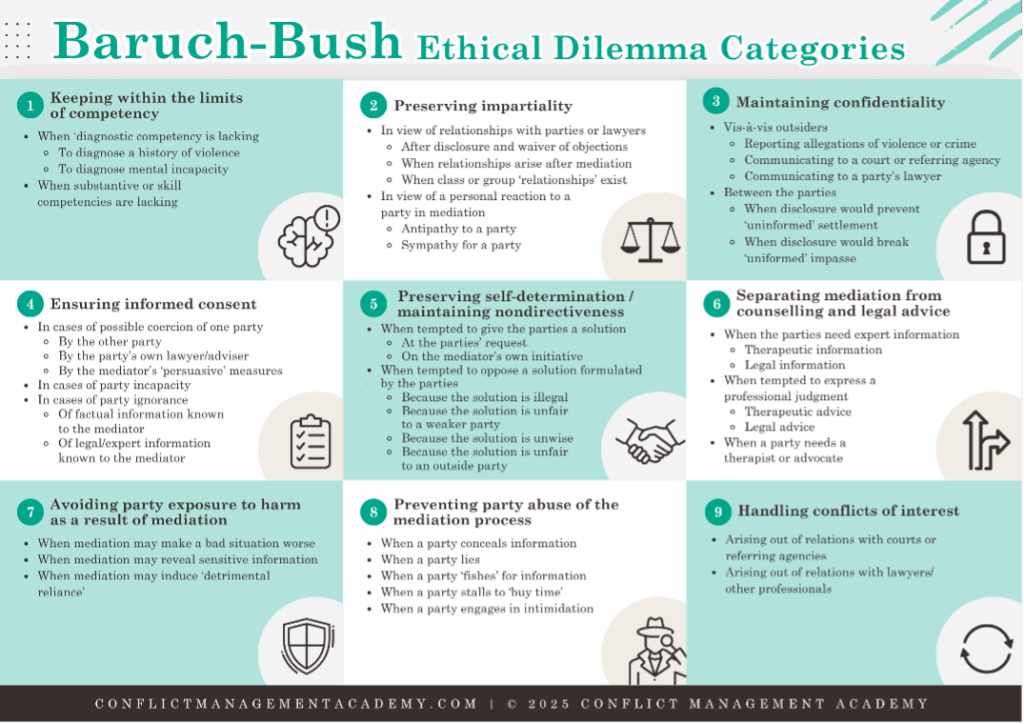
In my opinion, one of the most practical tools comes from Robert Baruch Bush, whose research in 1994 identified nine common categories (with numerous examples under each category) of ethical dilemmas mediators face:
Keeping within competency – avoiding work beyond your skill or qualification.
Preserving impartiality – managing bias or perceived bias.
Maintaining confidentiality – between parties and with outsiders.
Ensuring informed consent – avoiding coercion, ensuring understanding.
Preserving self-determination / non-directiveness – resisting the urge to impose solutions.
Separating mediation from counselling or legal advice – knowing the boundaries.
Avoiding exposure to harm – preventing physical, emotional, or legal harm.
Preventing misuse of the process – deterring fishing expeditions, stalling tactics, or intimidation.
Handling conflicts of interest – both actual and perceived.
Here’s a handy infographic that summarises Bush’s categories for easy reference:
But what should we actually do?
While codes and guidelines identify principles, they rarely tell you how to make a decision when those principles conflict. For example:
Is self-determination more important than informed consent?
When does preventing harm justify breaching confidentiality?
How should context, cultural norms, relationships, situational risks influence our choices?
Without a process, mediators risk falling back on ad hoc decisions, which are likely to be less well informed and harder to justify if challenged.
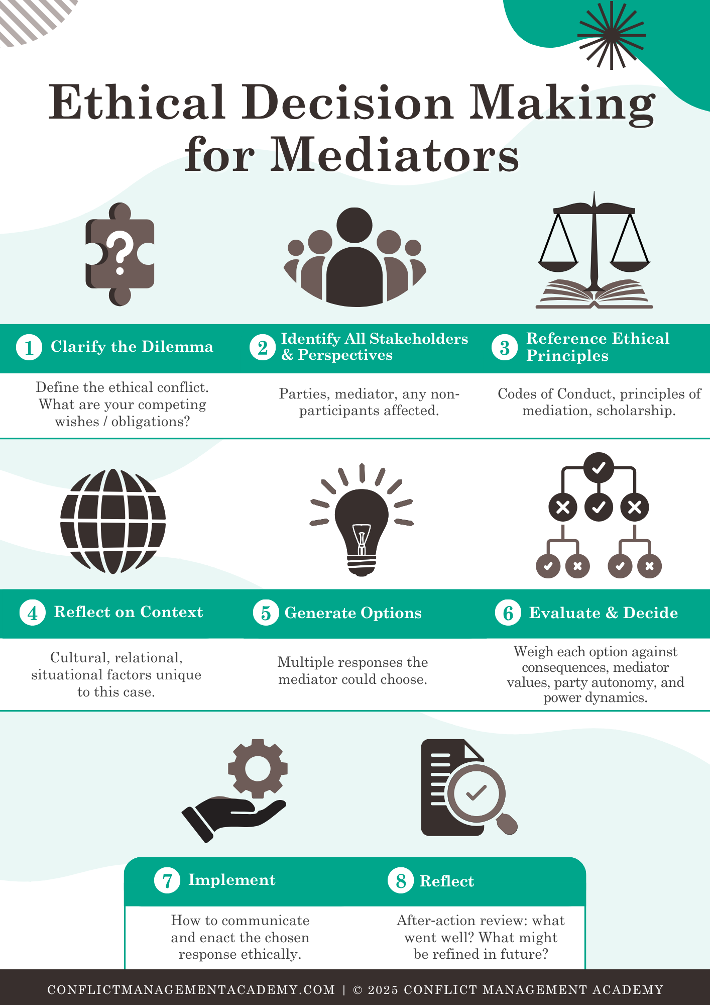
An Eight-Step Process for Ethical Decision-Making
The following approach has been adapted from social work and refined for mediation (originally by my colleague Olivia Rundle and I in an early article). It gives mediators a clear structure for navigating ethical dilemmas, with 8 steps (set out with more detail in the infographic below):
Clarify the dilemma
Identify stakeholders
Identify applicable ethical principles
Consider context
Generate options
Evaluate options
Implement
Reflect
Common Options in Response to a Dilemma
While the “right” choice depends on the situation, mediators often consider options such as:
Doing nothing (rarely ideal, but sometimes appropriate).
Reality-testing with the parties.
Taking a break to seek advice from a mentor or colleague.
Disclosing the dilemma to one or both parties.
Withdrawing from the mediation.
Reporting to relevant authorities or taking protective action.
There are many more possibilities depending on the dilemma, the stage of the mediation, and the particular circumstances. It’s important that, like we ask our mediation clients to do in mediation, we generate as many options as possible, evaluate them and then create a specific action plan.
This is another thing I have noticed working with students in mediation training – they tend to come up with one option and work to justify it, rather than thinking about multiple and lateral options and then evaluating them.
Also, they tend to come up with an action plan (e.g. report to the authorities) that is vague and incomplete. For example, to whom will they report? What will they say? Will they identify themselves? Will they share this decision with their parties?). In hypothetical activities we can be vague with no consequences, but in the real world we must act quickly and precisely. The more we practice precision in our hypothetical scenarios, the more we will be prepared in the event we face a dilemma in our practice.
Consequences of Acting Unethically
Potential outcomes include:
Legal liability – rare, but possible if conduct breaches laws.
Harm to parties or others – physical, emotional, financial.
Complaints and sanctions from professional bodies.
Damage to reputation – to the individual and the profession in general.
Missed opportunities for learning if we don’t reflect and share experiences.
In reality many unethical actions go unchallenged, but that doesn’t make them harmless. The absence of consequences is not the same as the presence of integrity.
Why Practice Matters
Trying to work through these eight steps in the heat of a mediation can be difficult. That’s why it’s valuable to rehearse using hypothetical scenarios (the mediation equivalent of a fire drill)! Practising with such scenarios in training, supervision, or reflective practice groups builds your repertoire of responses and your confidence in applying them.
Building an Ethical Culture in Mediation
Ethical competence isn’t just an individual skill. It’s a cultural norm we build together. By talking openly (within confidentiality limits) about ethical challenges, we normalise the idea that dilemmas are part of practice, not a sign of failure. We also expand our collective “library” of ways to handle them.
That might mean:
Incorporating ethical decision-making practice into professional development.
Participating in reflective practice groups or “mediator’s dilemma” forums.
Sharing anonymised case studies in articles, webinars, or conferences.
Encouraging a mindset of curiosity and humility, rather than certainty.
Ethics in mediation is rarely about black-and-white rules. It’s about learning to navigate the grey zones with care, courage, and a willingness to be accountable for our choices. With a clear process, a solid grounding in principles, and regular practice, mediators can face ethical challenges with confidence and model the integrity that gives our profession its credibility.
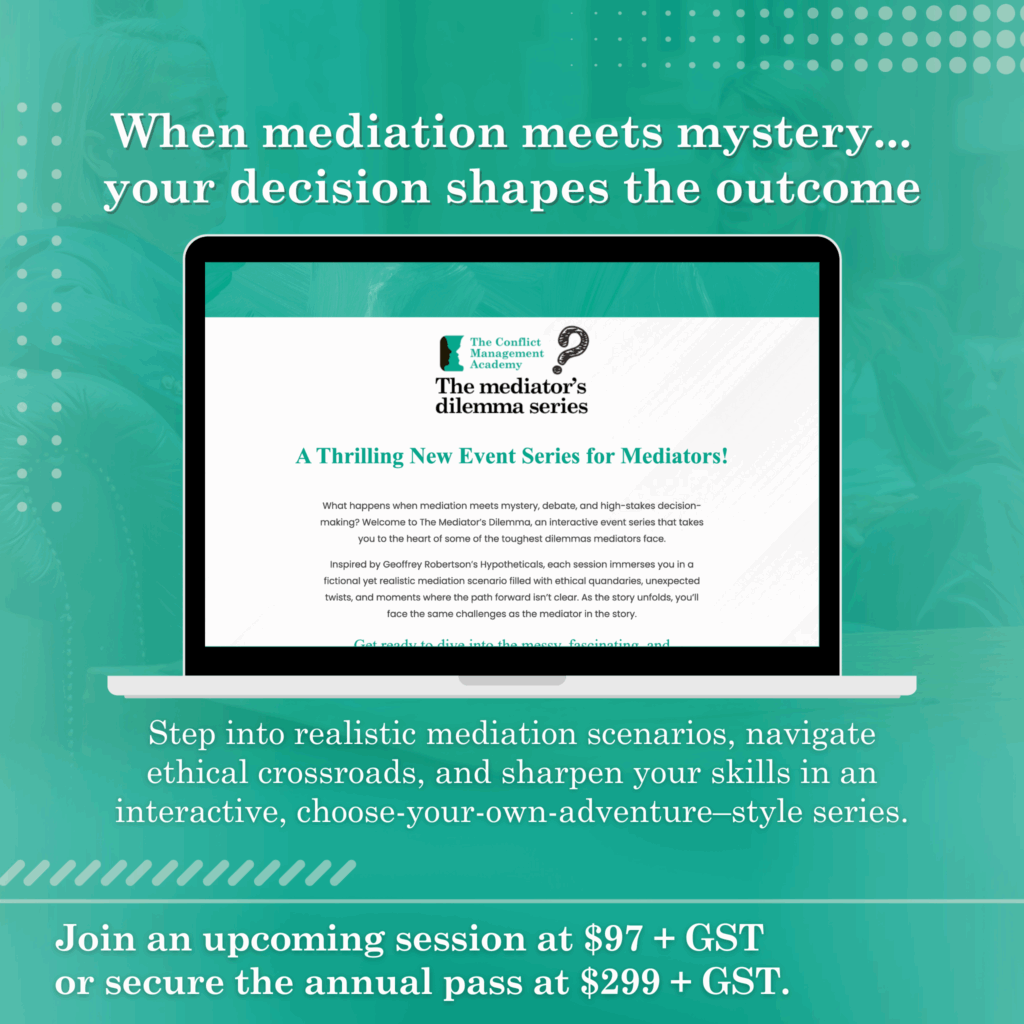
What happens when mediation meets mystery, debate, and high-stakes decision-making? Welcome to The Mediator’s Dilemma, an interactive event series that takes you to the heart of some of the toughest dilemmas mediators face.
Inspired by Geoffrey Robertson’s Hypotheticals, each session immerses you in a fictional yet realistic mediation scenario filled with ethical quandaries, unexpected twists, and moments where the path forward isn’t clear. As the story unfolds, you’ll face the same challenges as the mediator in the story.
The facilitator will guide you through the unfolding drama, pausing at critical “dilemma moments” to ask for audience engagement. Discuss with fellow mediators from diverse backgrounds. Whether you’re stepping into your first session or reflecting on decades of experience, The Mediator’s Dilemma offers something for everyone.
Get ready to dive into the messy, fascinating, and rewarding world of mediation like never before. The dilemmas are real. The stakes are high. And the answers? That’s up to you.
https://conflictmanagementacademy-stg.tangiblelaunchpad.com/mediators-dilemma-series-2025
REFERENCES:
Boulle (2023) Mediation and Conciliation in Australia, Chapter 10.
Hardy and Rundle (2012) Applying the inclusive model of ethical decision making to mediation. James Cook University Law Review.
AMDRAS Practice Standards (2024) Code of Ethics
IMI Code of Professional Conduct
Law Council of Australia Ethical Guidelines for Mediators, 2011.
Robert A. Baruch Bush (1994) A study of ethical dilemmas and policy implications. Journal of Dispute Resolution 1.
Omer Shapira (2021) Mediation Ethics: A practitioner’s guide. American Bar Association.
OTHER USEFUL RESOURCES ON ETHICS IN MEDIATION:
Akin Ojelabi, L. (2023). The Challenges of Developing Global Ethical Standards for Mediation Practice In: Comparative and Transnational Dispute Resolution, Routledge, Oxford, United Kingdom
Robert A. Baruch Bush (2019) A pluralistic approach to mediation ethics: Delivering on mediation’s different promises. Ohio State Journal on Dispute Resolution 34:459-536.
Zachary R. Calo (2024) Artificial intelligence and mediation ethics. Cardozo Journal of Conflict Resolution 26:211-233.
Cohen, “A Taxonomy of Dispute Resolution Ethics” in M Moffitt and R Bordone (eds), The Handbook of Dispute Resolution (Jossey Bass, San Francisco, 2005), Ch 16, p 244.
Rachael Field (2012) Mediation ethics in Australia: A case for rethinking the paradigm. James Cook University Law Review 19:41-69.
Rachael Field and Neal Wood (2006) “Confidentiality: An ethical dilemma for marketing mediation?” Australasian Dispute Resolution Journal 17(2): 79-87.
Rachael Field and Jonathan Crowe (2020) Mediation ethics: From theory to practice.
Carrie Menkel-Meadow, Ethics and Professionalism in Non-Adversarial Lawyering, 27 FLA. ST. U. L. REV. 153, 167-68 (1999).
Mary Anne Noone and Lola Akin Ojelabi (2014) Ethical challenges for mediators around the globe: An Australian perspective. Journal of Law and Policy 45: 145-193.
Mary Anne Noone, Lola Akin Ojelabi and Lynn Buchanan (2018). Ethics and justice in mediation.
Joseph Stulberg (1995) Bush on mediator dilemmas. Journal of Dispute Resolution 57-71.
Ellen Waldman (2011). Mediation Ethics: Cases and Commentaries. Jossey-Bass.